What is Hybrid Cloud Malaysia? A Practical Guide for Enterprises
What Is Hybrid Cloud and How It Works
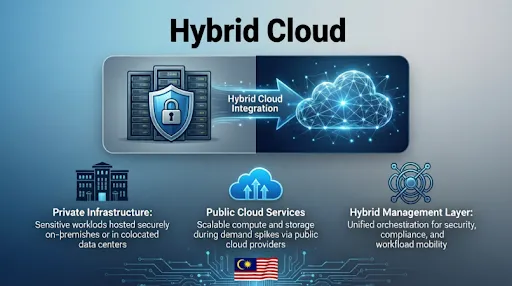
Hybrid cloud refers to a computing setup that mixes private infrastructure, public cloud services, and possibly on-premises or collocated data centres. With a hybrid cloud, a business can run sensitive workloads on private infrastructure while using public cloud for scalability when demand spikes. This model gives flexibility, control, and growth potential in a changing IT environment. In Malaysia, the cloud landscape is shifting as data sovereignty, regulation, and national cloud strategy gain importance. This guide will explain hybrid cloud in a Malaysian context, explore benefits and challenges, and provide a roadmap for enterprises that want to adopt it.
Recent years have seen a growing adoption of cloud services in Malaysia. The government launched the National Cloud Computing Policy (NCCP) in August 2025 to guide cloud adoption across sectors. The policy emphasises security, data sovereignty, inclusivity, and sustainability.
Given these developments, Malaysian enterprises face new choices. Hybrid cloud offers a balanced path that supports growth, compliance, and long-term planning.
How Hybrid Cloud Works in Real Enterprise Environments

In practice, a hybrid cloud is not just a mix of different platforms. It is an operating model that defines where workloads run, how data is governed, and who controls each environment. Enterprises use hybrid cloud to balance flexibility with control, rather than committing fully to a single cloud model.
In a hybrid setup, organisations decide which applications and data to keep on private infrastructure and which to place in public cloud environments. Mission-critical systems, regulated data, or latency-sensitive workloads often stay on private infrastructure, while public cloud is used for scalability, development, analytics, or customer-facing services. This separation allows IT teams to align infrastructure decisions with business risk and compliance requirements.
To make this work, enterprises rely on unified management, secure network connectivity, and orchestration layers that allow workloads to operate across environments. Technologies such as virtualisation and container platforms enable applications to be deployed consistently, regardless of where they run. The goal is not constant movement of workloads, but the ability to place each workload in the most appropriate environment.
In real-world scenarios, hybrid cloud supports practical use cases. For example, customer data and core financial systems may remain on-premises to meet regulatory and governance requirements, while digital channels, reporting platforms, or development environments run in the public cloud. Over time, this approach gives enterprises the flexibility to modernise at their own pace without disrupting existing operations.
Hybrid Cloud Benefits for Malaysian Enterprises
Hybrid cloud benefits are often discussed in broad terms, but their real value depends on how well they align with an organisation’s operating model, regulatory obligations, and long-term IT strategy. For Malaysian enterprises, hybrid cloud is less about maximising cloud usage and more about making deliberate decisions on where workloads run, how data is governed, and how risks are managed.
Optimised Cost Management:
Achieve a balance between predictable capital expenditures (CapEx) for stable, core workloads hosted on the private cloud and the flexible operational expenditure (OpEx) pay-as-you-go model of the public cloud.
Enhanced Flexibility and Scalability:
Gain the ability to dynamically scale resources, utilising the public cloud to rapidly handle unexpected traffic peaks (e.g., major e-commerce sales) without the need for extensive, costly upfront hardware investments.
Robust Security and Compliance:
Maintain critical data and applications in a secure, highly controlled private environment to satisfy specific regulatory obligations (such as Malaysia's PDPA), while leveraging the public cloud for less sensitive tasks.
Superior Business Continuity and Disaster Recovery (DR):
Strengthen data resilience and ensure continuous operations by replicating applications and data across both private and public cloud infrastructures, safeguarding against local service disruptions.
Accelerated Innovation:
Quickly adopt and utilise cutting-edge public cloud services, including AI and advanced data analytics, without the time and expense of upgrading on-premises IT infrastructure.
Why Malaysian Companies Start Shifting to Hybrid Cloud

Hybrid cloud is increasingly adopted by Malaysian enterprises as they face growing demands for scalability, compliance, and modernisation. First, hybrid cloud improves scalability and flexibility. Companies can tap into public cloud resources when workload spikes occur, and scale back when demand drops. This helps avoid over-investing in private infrastructure.
Second, hybrid cloud supports data security and compliance. Sensitive data can remain in private infrastructure or within Malaysia. The hybrid model lets companies meet regulatory and data-sovereignty requirements while leveraging public cloud for less sensitive operations.
Third, hybrid cloud supports legacy systems and gradual modernisation. Enterprises with older applications can keep those on-premises, while deploying new applications in the cloud. This reduces risk and preserves business continuity.
Fourth, a hybrid cloud can support reliability, disaster recovery, and business continuity. By spreading workloads across private and public clouds, companies can replicate data, shift workloads, and reduce downtime risks.
Finally, hybrid cloud aligns with long-term national digital strategies. The National Cloud Computing Policy (NCCP) outlines Malaysia’s direction towards a more secure and sovereign cloud ecosystem over the coming decade. Announcements by the Government of Malaysia have generated opportunities for enterprises to formulate cloud adoption strategies that ensure compliance and facilitate growth.
Regulatory and Data Sovereignty Considerations in Malaysia
Malaysia treats data sovereignty as a core factor in cloud adoption. In practical terms, data stored in Malaysia is governed by local laws and regulatory requirements.
For many businesses, data residency matters. Storing sensitive data abroad could expose it to foreign laws or regulatory frameworks. A hybrid cloud setup allows Malaysian companies to make informed decisions on where different data sets are stored, locally or overseas. This flexibility is key to handling sensitive information and making sure they stay compliant with all the rules.
The National Cloud Computing Policy (NCCP) introduces a more structured approach to cloud adoption. It classifies data by sensitivity level and links each level with deployment requirements. Enterprises should map their data and workflows to these sensitivity levels and decide whether to store or process them on-premises, in a private cloud, or in a public cloud.
Sectors such as finance, healthcare or government often require rigorous compliance. Hybrid cloud helps these organisations meet regulatory requirements while using modern infrastructure.
Challenges and Trade-offs of Hybrid Cloud Adoption in Malaysia

Hybrid cloud offers benefits but involves tradeoffs. Managing a hybrid environment introduces complexity in architecture, networking, and operations. Teams need strong integration, orchestration, and consistent policies across environments.
Effective hybrid cloud adoption depends on clear planning of data flows, security controls, and backup strategies. Misconfigurations or weak controls across environments can undermine compliance or data protection.
Choosing between private, hosted private, or public cloud involves weighing performance, regulatory requirements, and cost over time. Businesses should evaluate workloads carefully before placing them in public or private infrastructure.
Hybrid cloud environments demand both technical expertise and continuous governance to operate effectively. Without proper tools and expertise, an enterprise might struggle to monitor resource usage, control access, and enforce policy across environments.
A Practical Hybrid Cloud Adoption Roadmap for Malaysian Enterprises
Businesses can follow this roadmap to adopt a hybrid cloud in a structured way.
Map workloads and data by sensitivity, performance needs, compliance requirements, and expected growth. Decide which workloads belong on private infrastructure or within Malaysia, and which can go to public cloud.
Select cloud or service providers with a data centre presence in Malaysia, where required by regulatory or data residency considerations. Prefer providers that support hybrid cloud models and offer clear data-sovereignty guarantees.
Design a hybrid architecture with a clear integration plan. Define network connectivity (such as VPN or dedicated links), establish unified management and monitoring, and plan data flows, access control, and encryption.
Pilot the hybrid setup. Migrate non-critical workloads first, test performance, compliance, backup, and recovery. Evaluate cost, performance, and compliance outcomes before scaling.
Establish governance structures, security policies, data classification, and compliance procedures across environments. Document where data lives, who controls it, and how it moves between environments.
Review periodically. Reassess workloads, compliance requirements, growth forecasts, and adjust cloud strategy in response to business changes or regulatory updates.
Long-Term Planning and Trends

The National Cloud Computing Policy (NCCP) reflects a shift in Malaysia’s national approach to cloud adoption. The policy outlines goals such as strengthening data sovereignty, supporting innovation, and encouraging public–private collaboration, with the longer-term ambition of positioning Malaysia as a regional cloud hub.
Discussions around sovereign cloud and local cloud infrastructure point to the growing relevance of hybrid and sovereign cloud models. Businesses that adopt hybrid cloud now may be well placed to align with future national infrastructure.
Enterprises should treat a hybrid cloud strategy as part of long-term IT planning. Hybrid cloud offers a path to scalability, compliance, and flexibility while preserving control over critical data and workloads.
Conclusion: Hybrid Cloud as a Practical Path for Malaysian Enterprises
Hybrid cloud offers a balanced IT infrastructure model for Malaysian businesses. It provides a balance of flexibility, scalability, and control while supporting compliance and data-sovereignty requirements. Businesses in Malaysia can use hybrid cloud to modernise workloads, manage risk, and support growth under changing regulatory and market conditions.
Adopting a hybrid cloud effectively requires careful planning, mapping of workloads, strong governance, and thoughtful vendor selection. With the right strategy, hybrid cloud enables enterprises to build resilient, adaptable infrastructure while remaining aligned with regulatory expectations and business priorities.
Read More: Why Hybrid Cloud is a Game-Changer
WikiBlox: A Practical Hybrid Cloud Platform for Malaysian Enterprises
WikiBlox is a modern virtualisation platform designed to support hybrid cloud environments for Malaysian enterprises. It unifies virtual machine and container workloads within a single platform, simplifying management, migration, and scalability.
Built around strong governance and local compliance frameworks, WikiBlox helps organisations modernise their IT environments confidently. For enterprises evaluating VMware alternatives to traditional virtualisation platforms, WikiBlox offers a future-ready option developed and supported within Malaysia.
WikiBlox: A Hybrid Cloud Platform for Malaysian Enterprises

WikiBlox developed by Wiki Labs Sdn Bhd, is built on an enterprise-grade architecture integrating Red Hat OpenShift with Lenovo infrastructure powered by AMD EPYC processors, operated within Malaysia. The platform unifies virtual-machine and container workloads under managed operations with built-in governance, security, and compliance aligned to Malaysian enterprise standards.
A recent local deployment in the financial services sector showed measurable improvements in provisioning speed and operational efficiency. For enterprises exploring hybrid cloud, WikiBlox distinguishes itself through local support, regulatory alignment, and optimisation for hybrid-cloud and container workloads.
How Wiki Labs Helps Manage Hybrid Cloud Costs
Wiki Labs supports enterprises across the hybrid cloud lifecycle, from assessing existing environments to designing migration frameworks and optimising operations post-deployment.
Through cost-transparency analysis, predictable licensing models, and Malaysia-based support, Wiki Labs enables organisations to identify and reduce hidden costs associated with legacy systems. Its consultants offer clear insights into the total cost of ownership (TCO) across leading VMware alternatives, ensuring each client selects the most cost-effective and scalable approach for long-term growth.
With deep local expertise and platform-agnostic hardware integration, Wiki Labs supports Malaysian enterprises in improving cost visibility and long-term operational efficiency during modernisation.
Ready to Move Forward with Wikiblox Hybrid Cloud?
WikiBlox isn’t just another platform. It’s your all-in-one foundation for Malaysia’s enterprise IT future.
👉 Schedule a free consultation with Wiki Labs experts today to see how WikiBlox can power your transformation.
Disclaimer:
The information in this article is provided for general informational purposes only. All product names, trademarks, and registered trademarks are the property of their respective owners. References to third-party technologies such as VMware, Red Hat, Lenovo, AMD, and others are made solely to describe compatibility or comparison context and do not imply any endorsement or affiliation.
Wiki Labs Sdn Bhd makes reasonable efforts to ensure the accuracy of information at the time of publication; however, readers are encouraged to verify technical details and licensing information directly with the respective vendors.
