7 Reasons Enterprises Are Exploring VMware Alternatives in 2026 | VMware Exit Strategy Malaysia
Enterprise VMware exit strategy planning in Malaysia has become a central topic for IT leaders in 2026. Changes in licensing, pricing structure, and partner availability have shifted how organizations view long-term virtualization decisions. Many Malaysian enterprises now treat VMware exit strategy Malaysia as a governance and financial issue rather than a technical upgrade. This shift reflects a broader reassessment of cost control, risk exposure, and future readiness.
For more than a decade, VMware formed the backbone of enterprise infrastructure in Malaysia. That foundation is now evolving as enterprises reassess licensing structures, operational models, and long-term infrastructure strategies. VMware's exit strategy in Malaysia allows organizations to regain control over budgets and platform direction. The following seven reasons explain why this movement continues to accelerate in 2026.
Reason 1. Rising Licensing Costs Are Forcing Enterprise VMware exit strategy in Malaysia Decisions

VMware exit strategy Malaysia discussions often begin with cost analysis. Broadcom introduced subscription-based licensing tied to physical core counts and minimum thresholds. Many enterprises experienced immediate cost increases without workload growth. Finance teams struggle to justify higher spend for the same operational output.
Multi-year cost modeling highlights the issue clearly. Organizations comparing three to five-year projections see compounding subscription increases. Enterprises, therefore, begin evaluating a VMware exit strategy in Malaysia as part of long-term cost governance planning. Budget owners prefer platforms with clearer pricing and predictable renewal terms.
Foreign currency exposure adds pressure. VMware subscriptions are typically priced in foreign currency, which exposes Malaysian enterprises to exchange-rate fluctuations. VMware's exit strategy in Malaysia helps reduce financial volatility and supports stable long-term planning.
Reason 2. Cost Predictability Challenges Accelerate Organizations planning a VMware Exit strategy
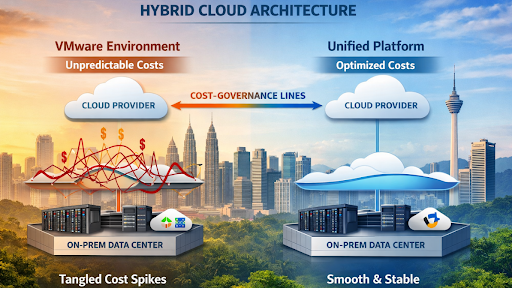
Predictable cost supports enterprise governance. Enterprise VMware exit strategy in Malaysia gains traction because subscription renewals vary year to year. Core-based pricing links licensing cost directly to infrastructure scale, meaning hardware refresh cycles may increase licensing spend. Every server upgrade increases licensing spend.
Enterprise planning requires stable forecasts. CIOs face pressure to provide accurate multi-year budgets. VMware's exit strategy in Malaysia supports platforms with simpler pricing structures and lower forecasting risk. Predictability improves vendor negotiations and internal approvals.
Cost uncertainty also complicates hybrid and cloud strategies. Enterprises want alignment across on-premises and cloud workloads. An enterprise VMware exit strategy can support unified cost governance across infrastructure layers.
Reason 3. Reduced Local Partner Coverage Drives Enterprise VMware exit strategy in Malaysia

Local support remains critical for enterprise operations. Enterprise VMware exit strategy in Malaysia discussions increased after changes in partner programs. Some enterprises report reduced access to local expertise following changes in partner programs.some enterprises express concern about response times.
Operational risk grows when local expertise declines. Enterprises depend on responsive support during outages, upgrades, and security incidents. Enterprise VMware exit strategy discussions often prioritise platforms with strong Malaysian partner ecosystems.
Support quality influences platform confidence. VMware's exit strategy in Malaysia aligns with vendors that maintain local engineers and support centers. This factor often outweighs feature comparisons during evaluation.
Reason 4. Vendor Lock-In Concerns Push Organizations planning a VMware exit strategy Forward
Vendor dependency creates strategic risk. Enterprise VMware exit strategy in Malaysia planning addresses concern over reduced negotiation leverage. Subscription governance and audit requirements have increased attention from legal and compliance team. Legal and compliance stakeholders now engage in infrastructure discussions.
Enterprises seek flexibility in platform decisions. An enterprise VMware exit strategy can reduce dependency on a single licensing model. This flexibility supports future architecture changes without financial penalties.
Lock-in also affects modernization. Cloud native services and container platforms require integration freedom. Enterprises therefore evaluate architectures that provide greater flexibility for future modernization.
Reason 5. Mature Alternatives Support Enterprise VMware exit strategy in Malaysia Execution

Alternative platforms reached enterprise maturity. Enterprise VMware exit strategy in Malaysia benefits from this evolution. Organizations evaluate hyperconverged platforms, open source virtualization, and hybrid cloud options with confidence.
Management tooling improved across alternatives. Backup integration, automation, and monitoring now meet enterprise expectations. Today, enterprises evaluate alternative platforms with greater operational confidence. Operational readiness reduces barriers to transition.
Vendor-neutral evaluation remains essential. Enterprise VMware exit strategy planning focuses on workload suitability rather than brand attachment. Enterprises select platforms aligned with operational and financial goals.
Reason 6. Hybrid Cloud and Modernization Goals Align With Organizations planning a VMware exit strategy

Application strategy continues to evolve. VMware's exit strategy in Malaysia aligns with hybrid cloud adoption. Enterprises modernize selected workloads while retaining stable legacy systems. This approach balances innovation and continuity.
Container platforms play a growing role. Modern hybrid platforms increasingly combine virtual machines and container workloads within a unified architecture. Flexibility improves application lifecycle management.
Workforce considerations also matter. Engineers prefer platforms aligned with industry trends. Enterprise infrastructure modernization can support talent retention and operational efficiency through modern tooling.
Reason 7. 2026 Marks a Critical Organizations planning a VMware exit strategy

Timing influences success. Enterprise VMware exit strategy planning in Malaysia gains urgency due to licensing renewal cycles and evolving infrastructure strategies.. Delayed decisions reduce options and increase cost exposure. Enterprises face renewal deadlines without leverage.
Early planning provides control. Early enterprise planning enables phased migration rather than rushed replacement. Controlled timelines protect uptime and business continuity.
The year 2026 represents a preparation window. Enterprises that act early avoid forced transitions later. Planning an enterprise VMware exit strategy in Malaysia now can reduce long-term disruption.
What a Practical Enterprise VMware exit strategy in Malaysia Looks Like

A practical VMware exit strategy in Malaysia begins with assessment. Enterprises' inventory includes virtual machines, licenses, and hardware cores. Accurate data provides clarity for decision-making. Cost modeling across multiple years reveals true exposure.
Next, teams classify workloads. Some remain on current platforms temporarily. Others move to alternative virtualization or cloud services. An enterprise VMware exit strategy in Malaysia benefits from phased execution rather than full replacement.
Pilot programs reduce uncertainty. Enterprises validate performance and support using non-critical workloads. An enterprise VMware exit strategy in Malaysia progresses through measured steps backed by real operational results.
Common Mistakes That Undermine Enterprise VMware exit strategy in Malaysia

Rushed decisions cause failure. VMware's exit strategy in Malaysia suffers when teams skip assessment. Hidden dependencies lead to outages during migration. Proper discovery prevents disruption.
Skill readiness matters. New platforms require training. VMware's exit strategy in Malaysia must include enablement plans. Teams operate more effectively with proper preparation.
Hidden costs also undermine planning. Backup, monitoring, and integration expenses add up. VMware's exit strategy in Malaysia requires full cost visibility beyond licensing.
How Malaysian Enterprises Should Start a VMware Exit Strategy in Malaysia Today

Start with visibility. Inventory your VMware environment. Document license metrics and hardware details. VMware's exit strategy in Malaysia begins with accurate data.
Engage stakeholders early. Finance, legal, and operations teams contribute valuable insight. VMware's exit strategy in Malaysia succeeds when alignment exists across departments.
Run controlled pilots. Test alternatives under real conditions. VMware's exit strategy in Malaysia becomes actionable through experience rather than assumptions.
Conclusion: Reasons for Malaysian Enterprises Exploring Other VMware Alternatives
VMware's exit strategy in Malaysia reflects a structural shift in enterprise thinking. Cost control, flexibility, and support drive decisions in 2026. Malaysian enterprises seek platforms aligned with long-term goals and operational clarity. VMware's exit strategy in Malaysia provides a disciplined path toward sustainable infrastructure decisions.
WikiBlox: Malaysia’s Modern Approach to Virtualisation VMware Alternative
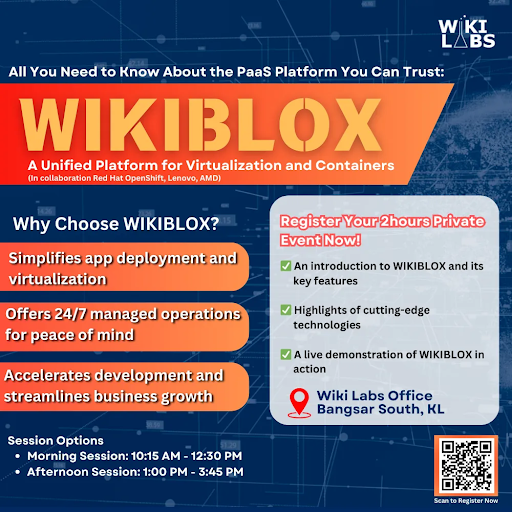
WikiBlox delivers a modern virtualisation foundation designed specifically for Malaysian enterprises. It unifies virtual machine and container workloads within a single platform, simplifying management, migration, and scalability.
Built around strong governance and local compliance frameworks, WikiBlox helps organisations modernise their IT environments confidently. For enterprises evaluating VMware alternatives, it provides a future-ready platform developed and supported within Malaysia.
WikiBlox: What You Should Know
WikiBlox by Wiki Labs Sdn Bhd is engineered on an enterprise-grade architecture that integrates Red Hat OpenShift with Lenovo infrastructure powered by AMD EPYC processors, all operated within Malaysia. The platform unifies virtual-machine and container workloads under managed operations with built-in governance, security, and compliance aligned to Malaysian enterprise standards.
A recent local deployment within the financial services sector demonstrated significantly faster provisioning and measurable cost efficiencies compared with traditional virtualisation environments. For organisations exploring VMware alternatives, WikiBlox distinguishes itself through local support, regulatory alignment, and optimisation for hybrid-cloud and container workloads.
How Wiki Labs Helps Manage Virtualisation Costs
Wiki Labs provides full-lifecycle services for enterprise virtualisation — from assessing existing VMware environments to designing migration frameworks and optimising operations post-deployment.
Through cost-transparency analysis, predictable licensing models, and Malaysia-based support, Wiki Labs helps organisations identify and reduce hidden expenses associated with legacy systems. Its consultants offer clear insights into the total cost of ownership (TCO) across leading VMware alternatives, ensuring each client selects the most cost-effective and scalable approach for long-term growth.
With deep local expertise and platform-agnostic hardware integration, Wiki Labs enables Malaysian enterprises to achieve operational clarity and sustainable cost efficiency in their modernisation journey.
Ready to Move Forward with Modern VMware Alternatives?
WikiBlox isn’t just another platform. It’s your all-in-one foundation for Malaysia’s enterprise IT future.
👉 Schedule a free consultation with Wiki Labs experts today to see how WikiBlox can power your transformation.
Disclaimer:
The information in this article is provided for general informational purposes only. All product names, trademarks, and registered trademarks are the property of their respective owners. References to third-party technologies such as VMware, Red Hat, Lenovo, AMD, and others are made solely to describe compatibility or comparison context and do not imply any endorsement or affiliation.
Wiki Labs Sdn Bhd makes reasonable efforts to ensure the accuracy of information at the time of publication; however, readers are encouraged to verify technical details and licensing information directly with the respective vendors.
